
Research results of the antifascist workshop
How do we define fascism?The enemy within
The word “fascism” originates from the Italian word “fascio” meaning “bundle” or “group”. This term is directly linked to Benito Mussolini’s early political movement, “fasci di combattimento” or “fight clubs,” which referred to a bundle of people united under a common goal.
- The earliest examples of fascist states can bee seen outside of Europe for instance in the formation of the Turkish Republic and the following genocides of armenian and syriac peoples.
- Fascism is deeply linked to social crisis. When the capitalist monopolistic system can’t maintain balance in society and the crises deepens due to their constant tendency to increase exploitation of society, the capitalist elite turns to fascism to control the situation and prevent social uprising (A. Öcalan).
- Fascism is tightly linked to the nation-statesince it represents a concentration of power in a central elite while expanding the area of exploitation controlled by that elite, in comparison to the preceding city-state system. This requires an increasingly artificial idea of “one nation” to legitimize why the society under that particular state’s rule should accept that order.
- Woman, as the first “occupied territory” and the first part of society to be enslaved is the first target of fascism, therefore patriarchy is one of it’s foremost frontiers.
- The mentalitythat has been created in society to make exploitation possible is also a root cause of what allows fascism to thrive under the nation-state. Therefore it is not merely a economical-capitalist cause but also a question of mentality.
- Through the rationalization of understanding of society that the Enlightenment stimulated a reductionist understanding of humanity was caused and as such the basis for fascism was created (T. Adorno).
- The separation of society, between us and them, has been the first step toward the mentality change that exploitation and capitalism requires. This is expressed in many ways, for instance extractivism against nature and racism against migrants.
- The middle-classis a reservoir of violence. When the state develops a fascist practice the middle-class is the main recruitment ground for fascist violence since they feel like they are one with the state.
- The fascist regime uses ideology that seeks to explain what the regime is doing (and why), putting it into a kind of frame of logic through the use of propaganda(H. Arendt).
- Violenceis a central tool of a fascist regime. Not only to defend the regime itself but also as an ideological tool to create fear and the sense of power.
- A radical transformation of the state occurs when it moves into a fascist phase. A mechanism of eliminating all possible opposition within the state itself is commenced.
- The “banality of evil” – the general population become participate in the violence of the state understanding it as a normal thing.
- Fascism is not just a political issue but especially capitalistculturecould pave the way for fascism through conformity, passivity and lack of critical thinking.
- Capitalism and fascism are linked but they are distinguishablefrom each other (Begaudeau)
What are the continuities and discontinuities between historical fascism and today’s fascism?
Characteristics of historical fascism
- Fascism was installed and upheld through military force.
- It was upheld and continued by mass movements.
- Even though fascism has made claims to revolution, once it takes power it has always defended the statu quo, the dominance of the bourgeois elite (Traverso).
- Fascism was used as a counter-revolutionary alternative at a moment where socialism and social democracy were strong movements and had the potential to lead a revolution
- Fascism wanted to “nationalize” women, to integrate them into the system that aim totalitarianism and mass mobilization, at the same time that it promote and mystify women’s traditional role as “mother of the nation’s children”.
- Male mentality has been the driving force of fascism in history
After the II World War
- The trauma left by Nazism and Fascism made it impossible to self proclaim as such for political tendencies with such goals.
- Fascism was practiced in the colonies through militaristic rule
- Imperialism put fascist methods into practice to fight back the Soviet Bloc, such as Operation Gladio and Operation Condor
- During the First World War, women had replaced men at the front in many professions, destabilizing gender prejudices and strengthening the influence of feminists. After the Second World War, although women’s emancipation was once again debated, the “housewife” model remained the most widespread.
Contemporary fascism – Neo-fascism
- We are in a period where fascism is emerging – a period of fascistisation – rather than in an era dominated by fascism (Bantigny & Palheta)
- There is a difference in the domestic and foreign policies of European states. In Palestine and Kurdistan they already form fascism.
- The use of digital technology to increase the level of control on the individual and the “optimisation” of the consumer and isolation of social struggle
- Young women of the new generations joined neo-Nazi groups. They perform the role of the “strong and violent”, while the home remains a place of extreme violence against women in these circles.
- The manipulation of the gains of the the feminist movements became a strategy of the fascists to attracting, exploiting and dividing women. Examples include the creation of self-proclaimed “identitarian feminist” groups are the rise of figures such as Marine and
Marion Maréchal Le Pen in France, Giorgia Meloni in Italy and Alice Weidel in Germany. At the same time natalist policies and masculinist “ incel” ideas spread.
The enemy within
- Despite the eclectic and sometimes contradictory expressions of fascism so far one common factor is the “National Myth” – the superiority of one nation over the others (M. Mohamed, P. Stambul)
- In the 1920s and 1930’s emphasis was put on the Jewish people as the enemy of the nation
- Today, Islamophobia has taken over the role as the main ideology of racist and fascist forces in Europe – this is a main factor in developing an anti migrant narrative in Europe
- Using the divide between Jews and Arabs to amplify a new politic of persecution, suddenly Israel is “good” and Islam is “bad”
Eco-fascism
- The acknowledgment that nature is under threat but identifying the threat as foreigners, therefore the conclusion is that protecting nature has to involve controlling or stopping immigration (P. Guillibert).
- To protect the environment it is seen as necessary to take authoritarian measures to force people to act differently
- Overpopulation has to be fought by “sacrificing some people”, first of all the migrants – and this should be done by enforcing borders and protecting private property
Liberalization
- Appropriating left-wing concepts and putting them at service for fascist practices
- Today a feminist argument is used for fascism and racist politics stating that especially muslim cultures mistreat women and should therefore be forbidden or marginalised
Legality and parliamentarism
- Just as the AKP and MHP in Turkey have formed a right-wing and fascist alliance there are similar alliances emerging in Europe, such as in France and in Italy.
- The legal parties are normalizing a fascist rhetoric and agenda and paving the way for fascism – this in some cases leads to mutual strength between parliamentarian and street fascism, in other cases it has lead to weakened street fascism.
- Liberal mass media also plays a key role in normalizing racist and fascist narratives.
- It is worth pointing out that the era of fascism during the Second World War was preceded by mostly legal parties which later turned into violent, fascistic movements.
History and analysis of anti-fascism
Phases of antifascist struggle:
There are different phases of antifascist struggle that have been evaluated:
- Pre WWII and during WWII (1920’s until 1945)
- Post WWII (1945 – 1990)
- After the end of real socialism (1990’s until today)
For the first phase the struggle is against the rise of fascism in the 1920’s and fascism as an established system.The second phase is, in the former fascist countries, a struggle against the old fascist and collaborators. The third phase is after the end of real socialism. This marks a rise of nationalism in former socialist countries and a rise of conflicts and racist violence. It also marks a disillusion of the left movements.
Forms of antifascist organisation
in 1. Phase
- Paramilitary organizations (often as wings of parties or unions) examples: Arditi del Popolo, Red front, Iron Front, Black Band
- Cultural groups (propaganda through arts or youth culture) examples: Agitporp Troups, Edelweißpiraten, Leipziger Meuten
in 2. Phase
- Urban guerrilla (as part of ‘68 movement) example: Action Direct, RAF, Brigate Rosse, FRAP, ETA, GRAPO
- Autonomus movements
- Subcultural movements example: Rock Against Rascism
- Unions in 3. Phase
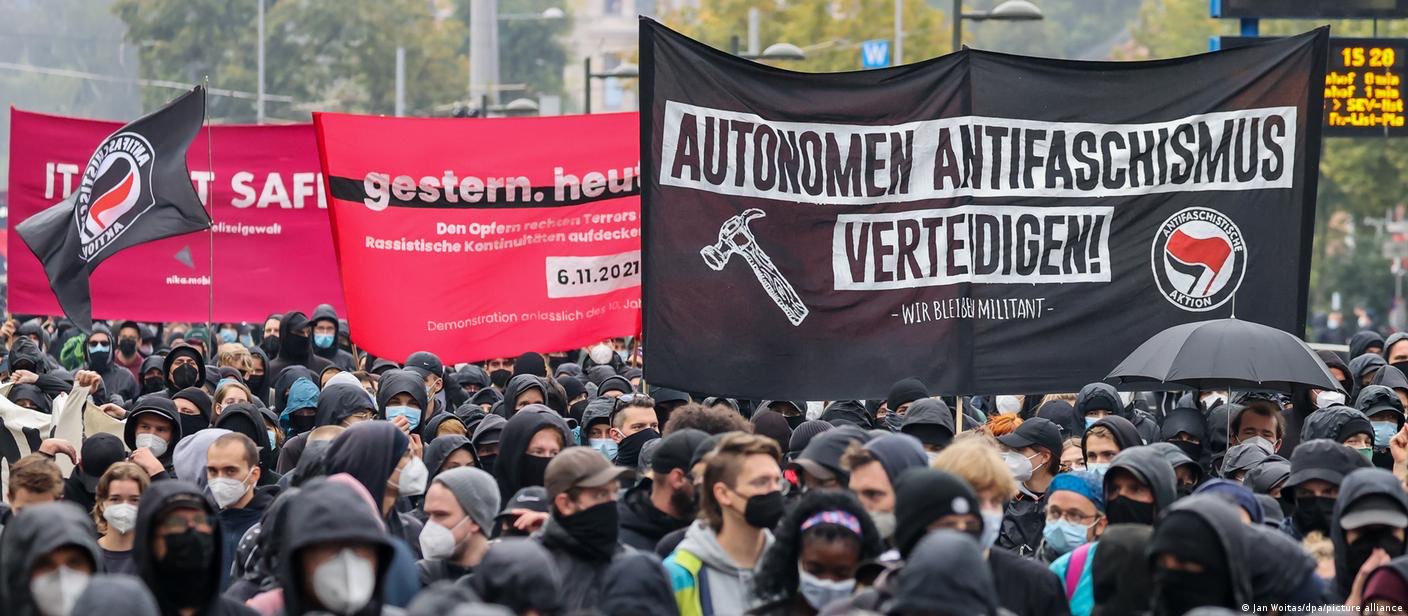
- Autonomus Antifa groups
- Unions
- Legal NGOs (institutionalization of anti-fascist politics)
Which methods lead to success?
The question, if a anti-fascist movement was successful can not be answered positively on strategical level. If fascism is the outcome of capitalist crisis and capitalism hasn’t been overcome, then there has not been a “final” success of anti-fascism.
On a tactical level there have been different successes. Outcomes of this are for example:
- Giving no space for fascist ideas
- Stopping physical violence of fascist groups or individuals
- Strengthening society’s morals and awareness
- Deligitimization of state institutions by replacing their supposed functions such as self defense
- Preventing a fascist movement from growing
Examples of success:
- Workers and migrants fight together against fascists in Britain and are able to prevent marches such as in August 2024
- Front Popular in France was built
- Spanish civil war, with internationalist support, a resistance was held for years
- Students organizing together with workers stopping fascist marches or fight for better working conditions
Reasons for defeat:
- No unity between different progressive forces, energy was used to fight each other instead of a common enemy
- International support was not strong enough to prevent fascism to break out in countries
- Anti-fascism could not give direct solutions for a social crisis (short term perspective)
- Anti-fascism is not connected to a holistic idea that shows a different option to the existing system (long term perspective)
- Society is organised but not strong enough
Conclusions and thesis
Characteristics that are common for large parts of Europe and that can be defining in the creation of a common and continental strategy to fight fascism.
The rise of fascism
- Fascism and extreme right is growing in Europe
- The increase of femicides in countries like Germany show how the rise of fascism is linked to patriarchy
- Fascism is using a strategy of provocation to divide the popular classes and divert attention from the oligarchies and the cause of social crisis which is capitalism
- In the face of growing social crisis fear is used to submit the masses to increasing authoritarianism and militarism
- The growth of fascism is pushing social democracy and traditional right in a reactionary direction
- Classism, patriarchy, racism and nationalism are used as a defensive reaction against globalization and the emergence of new identities
- Cultural battle is prioritized by fascism, amplified by social media, aiming to create a new cultural hegemony
- Post modern expressions such as identity politics inspired groups have emerged, labeling racism or nationalism as “just another identity” and thus normalizing it
- Anti-Jewish politics have given way to islamophobic politics
- Feminism and ecologism are being claimed by the ultra right wing, appropriating them and turning them into anti-migratory tools
- Within the nation-states there are very often suppressed or almost forgotten national identities. These often form basis for nationalism and separatism but can often also form a basis for democratic forces.
- Calls within fascist and ultra right wing ranks for “direct democracy” are emerging
- Right wing movements are against EU politics and more for their “own” national state
- The ultra right wing parties are actively seeking to build international relationships with their affinities
- Where there are underground organized armed fascist groups they also have connections with the state through the police force or even in the higher state institutions
- LGBTQ groups are targeted by fascists
The conditions of democratic forces
- Classical street fascism has been marginalized in many places but in some instances is still given a strong hand by the emerging parliamentary organizations
- The Antifa groups that were formed as a response to the threat of street fascism have naturally also stagnated or declined
- There are many anti-fascist fronts active but they have generally not managed to adapt to the neo-fascist parliamentary forms of organizing
- Many of the anti-fascist actions are reactions to fascist actions such as them holding manifestations and anti-fascists gathering to create obstacles
- Both fascist and anti-fascist groups are often found within hooligan and ultras culture
- Ecologists and decolonial movements are on the rise and often have an anti-fascist character
The future fight against fascism
- Femicide is one of the most urgent and severe consequences of patriarchal mentality and fascist practices – therefore the anti-fascist struggle and the struggle for women’s liberation and protection have to be seen as one
- Positive values such as feminism and ecologism are being appropriated by fascist forces – therefore a strategy and an approach is needed to take these values back to a democratic, feminist and anti-colonialist meaning
- Since the link between social crisis caused by capitalism and the emergence of fascism is evident the anti-fascist struggle has to be anti-capitalist as well
- The main mobilization ground for fascist and racists politics is today the ultra right wing in the parliaments – the strategy therefore has to include a struggle against these forces
- Fascism is not just a physical attack but also a cultural attack on society – awareness of this has to be created and methods to confront it on the cultural arena have to be defined
- Fascism tends to protect private property therefore the collectivization of such is an important element in the struggle against fascism
- Capital is trying to use fascism to divide society – a response therefore has to be internationalist, forging bonds between peoples, identities and nations
- The fight against fascism is closely linked to migrant struggles, they are mutually dependent and must be thought of together
- The right wing is today in many territories better than the left at connecting with the grass roots – a successful anti-fascist struggle therefore has to include ways to find back to society
- Under the guise of territorial defense, nationalism is appropriating the fight for land – the local struggle has to be built upon a mentality of non-exclusion and plurality
- An anti-fascist alternative has to be able to offer direct solutions to social problems to become a real alternative to populism
- Forces fighting against fascism and for democracy have to learn to work together and build bonds on common ground to develop the force needed to stand against fascism
- Liberal ideology is good at dissecting reality and turning it into separated and consumable entities that it can use whenever it pleases – an anti fascist response has to be able to explain reality in a holistic and congruent manner to point out the arbitrary ideology of fascism
- It is part of the struggle against fascism to be able to express and practice the kind of world we want to have instead.
- In anti-fascist spaces, we need to identify and fight against approaches that: overvalue
- everything that is masculine, and replay a fascination with the masculine figure of the “antifa”, relegate feminist struggles to the background, are violent against women or others, assign rather invisible tasks to women/LGBT and ‘valorizing’ and ‘spectacular’ tasks to men
- We need to find solutions to behavioral problems within organizations, freeing ourselves from purely punitive, stigmatizing, intolerant or moralistic approaches.