A Meeting of Seekers of a Free and Democratic Life
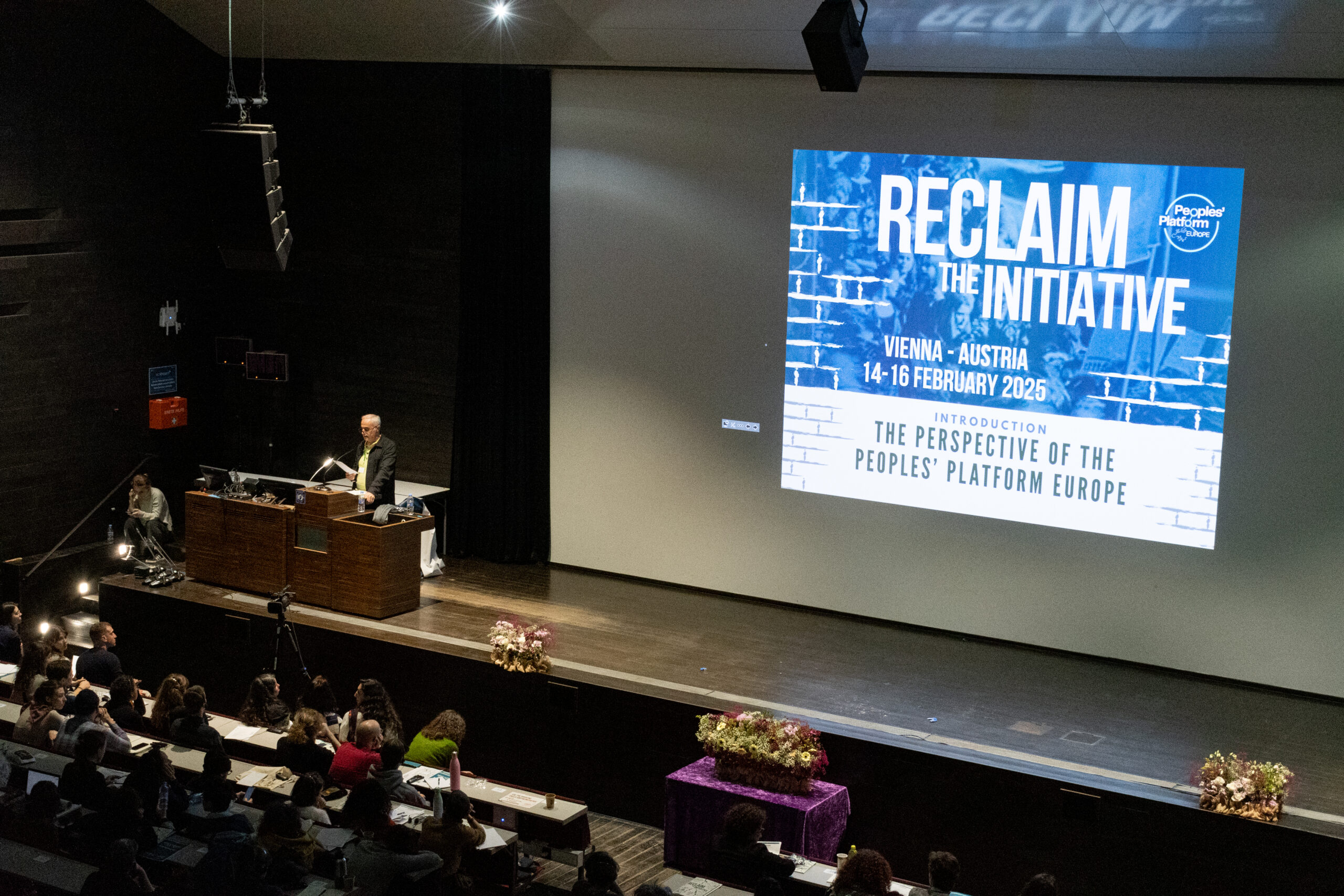
perspectives of the Peoples’ Platform Europe 2025
The Peoples’ Platform Europe, under the slogan “Reclaim the initiative!”, was born out from the need to share the experiences of those who struggle against the forces of oppression and to discuss the possibilities and opportunities in the search for a free life. Today, we have come together not only to analyze capitalist modernity or to assess the current situation but also as a community dedicated to understanding, addressing, and collectively finding solutions to the most urgent issues of our time. The world is on the brink of a historic change. The geopolitical changes, technological advances, ecological destruction, and economic-social crises we face are at an unprecedented level in both their complexity and impact. But with every great challenge comes the potential for great opportunity. Our capacity to learn, innovate, build solidarity and create alternative solutions is key to realising these opportunities.
Why do we need such a platform?
Today’s crises of economic instability, ecological collapse, social alienation and political dysfunction demand urgent solutions. But these challenges can only be fully understood through a profound analysis of the systemic dynamics of capitalist modernity and the historical trajectory of Eurocentric capitalism. Beginning in the 16th century, colonial powers imposed violent systems of resource extraction, land confiscation and labour exploitation. These actions dismantled local economies and communities and laid the foundations for a Eurocentric hegemonic global economic order, a system that thrives on domination and perpetuates dependency.
Historically, capitalist modernity has operated in a spiral of permanent crisis. These crises erode economic, political and social structures, while the system sustains itself by masking its vulnerabilities and devising new mechanisms of control. The Cold War era illustrates this dynamic as a major turning point. The geopolitical, economic and technological changes that followed the Cold War consolidated the hegemony of the capitalist system. This period was marked by increased repression of popular and revolutionary movements around the world.
The end of the Cold War and the geopolitical-geoeconomic interactions caused by the new technological and industrial development-revolution led to the imposition of a ‘unipolar system’ or so-called ‘new world order’ under the hegemony of the USA. These aimed to eliminate popular and revolutionary struggles, especially those of workers, women, students and youth, indigenous peoples’ and national liberation movements, and ecological-environmental struggles. While some of these were drawn into liberalism and thus neutralised, others were criminalised under the pretext of “counter-terrorism”. It was under these conditions that we entered the 21st century.
Although the unipolar international system under US domination managed to control Western and Eastern Europe for a long time, to manage the Asian economic crisis in the late 1990s and to partially manage the global financial crisis of 2007-2008, it also accelerated a serious and antagonistic struggle for hegemony with the global capitalist system. Despite their own internal contradictions, the forces of capitalist modernity have cooperated against the oppressed. As the so called “New World Order” project was built on trade wars, cultural domination, interdependence, international migration and internal hegemonic competition for a greater share of capital accumulation, the contradictions between the segments on the periphery of the unipolar world system and those seeking their sovereignty deepened.
In contrast to the nationalists, who seek to maintain themselves through nation-state capitalism, the globalists, who seek to maintain their dominance through global production chains, digital networks and transnational organisations and companies (Apple, Amazon, Microsoft, Metaverse, the electronics industry and the automobile sector), are using their technological advantages to control society with bio-power methods, using the bio-technical and communication-technical possibilities at their disposal. They practice the logic of “only the strong have the chance and the right to live”, a kind of “Political Darwinism”. While the globalists, who seek more exploitation and profit through the abolition of national borders, want to hold the world together horizontally, they want to classify humanity vertically. The aim of these efforts is to create, on a global scale, a society that is culturally uprooted and thus homogeneous, politically helpless, morally collapsed, alienated from nature and trapped in virtual patterns of life.
In order to overcome the crisis that has been deepening for decades, the globalist forces are now trying to transform capitalist modernity – including its three pillars: capitalism, the nation-state and industrialism – organisationally and paradigmatically. The capitalist forces are not trying to overcome the crisis; they are trying to make profit by managing the crisis, by deepening the crisis.
Contradictions and rivalries between the USA, the EU and classical nation-states
For years, leading EU representatives have been talking about the ‘strategic autonomy of Europe’ and have predicted that the EU will defend its interests globally through the ‘language of economic power’. EU member states, primarily Germany and France, are trying to gain an advantageous position in the emerging multipolar world order through an alliance that is politically, economically and militarily united. As such, they have sought to increase EU membership by adding new members from the Balkans to the Caucasus. Since the early 2000s, many EU countries, led by Germany and France, have pursued a policy of establishing economic relations with the other two major powers in Eurasia, Russia and China. But with the Ukraine war, the EU was forced to admit that it still lacked the necessary autonomy and power to pursue a self-sufficient policy that did not rely on forming alliances with one of the parties to the conflict, the United States or Russia and China.
The international institutions that the dominant system established especially after the Second World War; the United Nations (UN), the European Union (EU), NATO, the Council of Europe (CoE), the Arab League, the Shanghai Cooperation Organization (SCO) and many other economic and security institutions are now being used by the system powers against each other, let alone no longer maintaining the system. These platforms have turned into platforms for the balance of power between the ‘great powers’. These institutions, which have become areas where concepts such as human rights, peace, human values, women’s rights, reconciliation, etc. are emptied of their meaning and used against each other, are now in a phase where law and norms no longer work.
Not only are these institutions dysfunctional, but they are also essentially manifestations of a deadlocked system. It has caused major crises like energy supply issues, rising inflation, food supply crises, large-scale involuntary migration and security. Thus, the hegemonic powers of the system have essentially become an ideological-military-intelligence ‘minority’ that dominates the ‘majority’ that rejects their social and ideological logic and political methods.
The system is in a constant state of war against society
The crisis of global capitalism, the failure of positivist science and knowledge production, and the contradictions of the nation-state are deepening social discontent. The project of creating a consumer society is increasingly leading to spiritual and moral emptiness and decay. This should be read as a loss of truth in modernity. In terms of technology, the development of mass communication channels and social media networks are key points to be confronted in the coming times. They allow a more subtle shaping of thought, greater individualisation of people and the spread of misogyny and right-wing ideology. The system, which has reached an ideological and truth impasse, is now planning to control people by means of misuse of ‘artificial intelligence’.
The system, which constantly creates wars and crises by printing money without any backing in order to protect and sustain state capitalism on the pockets and backs of the people, has in a way structuralized the crisis with its own hands. In this context, the US, together with its imperialist allies and agents in the Group of 7 (G7), is constantly waging various forms of wars of aggression against rival powers and the peoples of the world.
In order to make more profit and eliminate internal crises, the capitalist system relies on the strategy of occupying, destroy/rebuild, depopulate/repopulate. We see this most openly in the ongoing wars in Palestine, Kurdistan, Ukraine, Lebanon and Syria. The destruction/depopulation and reconstruction/reorganisation of areas is the aim of these wars.
Capitalism tries to achieve results by discrediting and differentiating the values of democratic-communal society. Especially in the face of women’s liberation struggles, which force the system to change radically, it tries to multiply the ways and methods of maintaining itself by developing policies with a thousand and one masks. On the one hand, it continues its policies of instrumentalising women with the rising fascism with the face of women, which has developed in Europe in recent years, and on the other hand, it continues its policies of taking away the power of women by returning them to their traditional place in society. On the one hand, it implements the policy of victimising women to the strictest policies of the patriarchal system by cooperating with the forces that consider women as the property of men and deprive them of all their rights. However, women’s liberation struggles are the guarantee for achieving a democratic and free society.
In addition to destroying societies, the capitalist system is ruthlessly plundering nature for more resources and profit through the use and development of technology. The ecological crisis we are experiencing today has reached a level where life cannot be sustained. Widespread forest fires, hurricanes, floods, droughts, melting glaciers, the sinking of islands in the oceans, the effects of extreme heat and drought, the drying up of lakes, limited food resources, shrinking energy resources and the politics of ecocide pose great dangers to the future of the planet. Factors such as inflation, high cost of living, trade and sovereignty wars, social unrest, geopolitical conflicts and the increased possibility of nuclear war make the future more unknown and dangerous. In addition, excessive and unsustainable levels of debt, the decline in social investment and the rapid and unlimited development of military technologies are returning to societies as oppression and exploitation. The problems show that the systemic crisis is now structural – it is not accepted by society and is in the process of collapsing. Therefore, protecting not only people but also nature is the basic condition for defending life and represents a revolutionary effort.
Areas of social resistance
The ongoing war is essentially ideological and hegemonic in nature. Its main purpose is to change the political system established in the 20th century and adapt it to the conditions of the 21st century. Such economic, political, diplomatic and military struggle processes, in which old structures and balances are destroyed, and new structures and balances are sought to be established, are important transitional processes in which strategic transformations are experienced. These are phases in which both the peoples and revolutionary forces and the hegemonic powers can make significant gains if they act in a prepared and organised manner. As the most important theoretician and leader of the Kurdistan Freedom Movement, Abdullah Ocalan said: “Undoubtedly, hegemonic powers do not always win in big wars, peoples can also gain a lot. In fact, hegemonic powers can systematically lose, peoples can systematically gain”.
Especially in the last 10 years, it has become clear that people all over the world – not only in the peripheries but also in the centers of capitalist modernity – are increasingly protesting, objecting and revolting. People’s contradictions with the system of capitalist modernity are deepening on an individual and collective level.
The struggles that have been wagging around the world have resonated in Europe. In the US, the Black Lives Matter movement emerged against the structural state violence and executions against black people caused by white supremacy. Actually, the last words of George Floyd, “I can’t breathe”, truly expressed the emotional state of societies around the world. The Ni Una Menos (Not Another Less) movement, which began in Argentina in 2015 against feminicide, spread beyond the Abya Yala continent, leading to transnational and organised struggles in countries such as Italy and Portugal. Around the world, movements against harassment and rape culture have grown. In 2019, the Las Tesis protests, which began in Chile and spread around the world, said that the patriarchal system and the state were at the root of harassment and rape. In 2022, with the murder of Jina Amine, the ‘Jin-Jiyan-Azadi’ protests, which spread around the world and were taken up not only by women but also by men, showed the rebellion of women and society against the patriarchal capitalist system and the power of the demand for freedom.
At the end of 2018, the yellow vest movement was born in France in response to the rising cost of living. The “biggest strike” for 30 years took place in Germany. There were widespread workers’ actions in England. The resistance of Belgian peasants is an important part of the social movements. The environmental movements in many countries made the crisis of the system more visible. In addition, societies in many parts of the world have developed forms of resistance that challenge anti-democratic regimes and oppressive state power.
Collapsing Liberalism and Western Democracy
With the spread of the Third World War, the hegemonic powers are now struggling to renew themselves. In Europe, the political plane is moving towards fascism and the extreme right with the rise of centrist, nationalist and racist parties. Hostility towards women, youth, nature, labour and immigrants is not only the policy of the extreme right, but also of the centrist parties. Far-right parties are not the cause of this situation, but the result. The states point to racist and extreme nationalist circles (pest) as a method to make people accept the system (cholera). Here the aim is to destroy the power and determination of societies to fight against the system through the politics of security and fear.
It is not enough to explain the crisis of capitalist modernity only in economic terms. The notion created by liberalism that “you have the freedom to choose and do what you want” is collapsing. Every moment, people are being told what to choose and what to do as a result of digital data collected about them. Decisions are no longer made by so-called “free people”, but by transnational systems and corporations that direct them in their own interests. The latest technological developments are used with the logic of maximum profit, rapidly moving towards the classification of humanity as irrelevant and useless. Once again, “social engineering” is in full swing to create a single type of human being.
Public confidence in Western democracy is declining. Low voter turnout reflects this loss of faith in elections and political leaders. Police violence against protests, a basic democratic right, further undermines confidence. Throughout the EU, states are prioritising militarisation over social welfare. The billions spent on arms in the Ukraine-Russia war are a small example.
What to do?
Given the damage that the crises of the system have caused to society, there is widespread expectation of even greater economic and social crises in the coming years. Demands for change are growing. But how should this change take place?
The majority of the European left is still weak when it comes to reinterpreting the world and Europe. They unfortunately lack the ability to understand and analyse the global context and connections, to produce the political programmes and strategic struggles that the times demand. Also, most solutions they propose are expressed mainly in post-modernist discourse. There are legitimate demands such as defending identities and freedoms against ethnic, religious and sexual oppression, actively opposing ecological destruction, supporting immigrants and opening up space for local politics. However, there is a danger of moving from an “alternative to capitalism” to an “alternative within capitalism”. This is one of the main reasons for the rise of the right.
The classical European left urgently needs to be more clearly opposed to reformist understandings and policies. It needs to have more concrete practical policies that are intertwined with society. Beyond identifying and defining crises, it needs to overcome serious blockage and repetition in terms of developing solutions and alternatives. For example, prioritising the struggle within the parliamentary system as a continuation of a revived form of left populism cannot bring the change it promises. In fact, it delays the ground for radical change. On the other hand, the forces outside the system, although they have important proposals and projects, are not sufficiently organised and have yet to create the expected changes or the necessary organisations.
New challenges and opportunities
In the face of the environmental crisis, the ecological movement will radicalise and become more locally organised. Although the mass movement has diminished since 2019, the struggle is focused on concrete projects and territorial defence. Young people are particularly involved. By fighting for climate justice, they are also developing a just perspective for the future of planet Earth.
The feminist struggle has the potential to pioneer mass movements and organisations through participation and leadership. If it succeeds in insisting that the liberation of the most oppressed is the measure of the struggle for freedom, it can play an immensely profound role in the reorganisation of life in all sections of society and throughout the world. The democratic communalist process is onlyan updated version of mother-women sociality. Social truth can only be reached through this method.Unless the patriarchy imposed on society is overcome, socila truthwill not be revealed in all its dimmensions in term of phlosophy, science, ethics, aesthetics an religion. Only in this way can the right path be found regarding ecological destruction, social inequality and individual freedom.
The defence of basic needs (workers’ rights, salaries, housing, time, etc.) and the constant struggle against new measures taken by governments and the fight to maintain decent living conditions must gain strength in the form of local and specific but coordinated struggles. There is a new understanding of the different forms of the proletariat (or working class) and oppressed peoples, and if this is included in the class analysis, more realistic and faster solutions can be found.
Organised forms for the struggles for democracy and freedom against the system are needed. At the same time, they need to build diverse links with each other in a democratic and confederal way. An effective response to multiple crises and chaos can only be given through multiple democratic alliances. This must strike an optimal balance between the local and the global, the particular and the universal, the original and the common. While our age provides the necessary technical means for communication, organisation, coordination, exchange and commonality on a global scale, the main ground on which the struggle will be waged must be local.
The effectiveness of this platform depends on grassroots organisation and a concerted effort to tackle problems at their roots. Achieving our goals requires a framework that emphasises action and ongoing dialogue within progressive forces at the regional level.
By fostering cooperation between localised struggles, we can build a collective force that not only tackles specific challenges but also works to build a broader anti-capitalist movement.
This holistic approach allows us to link individual efforts to a larger narrative, creating a united front against systemic injustices. Through this synergy, we can amplify our impact and drive transformative change.
This is a huge and historic responsibility that falls on everyone’s shoulders. As those struggling in the context of Europe, we also have a duty to dismantle the unfreedom, injustice and destruction caused by European power around the world.
We are convinced that a process of collective discussion on the broadest possible platform of democratic and revolutionary organisations, movements and collectives is necessary to find the right answers to the questions of our time. With the People’s Platform Europe, we want to offer a transnational European framework in which we can have this exchange and find solutions to the existing problems.
Yes, we are the majority and have the motivation to “Reclaim the initiative!”
ALSO IN YOUTUBE: