Building autonomy, from local to international
1. Ideological and political analysis
To start a common discussion, it is important to have a common basis around which to discuss. For this purpose, we wrote this general ideological and political analysis that we now share with you. In the first part, you will learn about the ideological analysis of history through the lens of the democratic and capitalist rivers; the democratic nation will be proposed as a political solution to restore the autonomy of society; and examples from the existing praxis in Europe will be outlined to further develop the framework and base it in reality.
We live in a world where the problems caused by patriarchy and capitalist modernity are becoming increasingly clear and tangible. In the midst of the third world war, the global political crisis is deepening and life itself is clearly under attack, as we see in the many feminicides, ecocides and sociocides. In the face of a collapsing world, many are asking: What kind of a societal system do we want to live in? How can we create a free and self-determined life? What are the characteristics of a societal system in which we can build an alternative model of life, beyond the capitalist system of neo-colonial exploitation, made possible by nationalist, racist and patriarchal structures?
In different countries in Europe, we see that the violence and the attacks against life are on the rise; more importantly, the perpetrators are getting younger. For example, in Germany and other European countries we are experiencing growing feminicide rates, with a woman or a girl being murdered every other day. In addition, more young people are voting for right-wing parties, as the shift to the right increases in Europe and more right-wing governments and states become established. This also results in a stronger division of society and violent attacks on women and migrant people.
At the same time, we are experiencing the hottest summers, with many forest fires, floods and an increase in storms. Regarding health, more and more people are affected by illnesses and, above all, mental illnesses, especially loneliness and depression. We are facing big problems in the healthcare system, where capitalist modernity is making us ill, through pollution, the bad food we are eating, war, and more. All the crises are simultaneously making Europe fit for war. From schools to advertising on digital media, militarism is forced upon society, preparing us for war. We can follow along while the production and export of weapons are making billions in profits, and the finances for healthcare and education systems are being massively cut back. We watch a genocidal policy against humanity and life unraveling, enforced by a system that profits from it; be it with weapons or through ideological special warfare, the patriarchal-capitalist system attacks all aspects of life.
On the other side, society is uprising, protesting, organizing itself against the attacks and is always in search of answers, of a long-term solution. In times of chaos and crisis, there is always the possibility for change, the possibility for a revolution. But we have to organise this potential, by understanding the crisis worldwide better and creating effective actions.
The rivers of democratic and capitalist modernity
To understand what it means to build a free and self-determined life, we first need to deepen our understanding of what we are facing – capitalist modernity – and to understand why there is the need to build autonomy. Throughout history, with the avant-garde of women in society, the democratic river was flowing, and society organized itself around its own needs. With the figure of women and mothers in the center of society, society was able to govern, sustain and defend itself. It was a natural society, one based on communal values, and one with a natural autonomy that existed beyond power, nation-state and violence. The universe was orientated around the essence of women, the essence of nature was equal to the human essence, and autonomy was the natural way of organising and being of society.
With the emergence of patriarchy, the river of power and violence emerged and became stronger in capitalist modernity. Patriarchy – older men in society, including priests and former hunters – saw the importance of women, so in order to gain power with violence, these communal values were heavily attacked. Patriarchy was feeding off the strength of women – or democratic modernity – turning women more and more into slaves to the system throughout history. When we speak of capitalist modernity, we are not referring solely to capitalism and the production of surplus value, but rather to a system that monopolizes power by anchoring it in the nation-state, industrialism and capitalism. The strength of capitalist modernity lies in its ideologies such as sexism, scientism, religionism, nationalism, colonialism and liberalism, which were and are implemented through violence and oppression.
In Europe in particular, liberalism has penetrated deep into society and has established itself as the dominant ideology. Creating a false feeling of freedom, liberalism leaves us incapable of acting and absorbs or integrates our free thoughts and utopias into the nation-state. We surrender our ability to think freely and to act freely to a state and thus lose the possibility of a self-determined life. With other ideologies such as sexism, religionism, scientism and nationalism, the nation-state is dividing and oppressing society by splitting it in different parts and building one hierarchy on top of another.
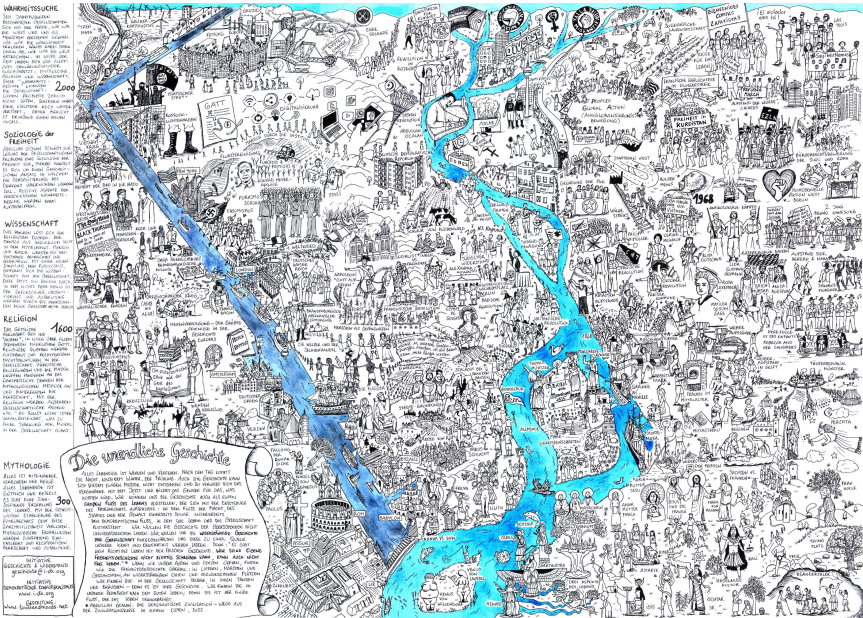
The Rivers of Capitalist Modernity and Democratic Modernity
(made by the Initiative for Democratic Confederalism or IDK, Germany)
While capitalist modernity only exists through the exploitation of women and society, democratic modernity is not dependent on capitalist modernity. A self-determined life means freedom, means a life in harmony with society and nature, the starting point of which is life itself. It means democratic modernity. We can find democratic modernity in anything and everything that opposes the patriarchal-capitalist system through its existence and actions. Despite all attacks of patriarchy, violence and power, Abdullah Öcalan shows us how democratic modernity expresses itself through many examples and meanders throughout history, like a dichotomous river since the emergence of civilization. Today, as we are confronted with the crisis of capitalist modernity, we can learn from this history. Our democratic history shows us that we can create an alternative life. For this, there is a need to research the source of a free life again, based on the democratic nation, which is attacked by the nation-state.
Approaches to alternative models of society that break with the principles of the global capitalist system are emerging all over the world. Democratic, grassroots, ecological and women’s movements around the world are grappling with the crises of our time and trying to formulate answers. In many places, local self-governing structures are emerging, such as neighborhood organizations for the defense of society. These answers cannot be completely the same everywhere, but the question arises as to how we can effectively organize society together. To overcome the hegemonic system, we need to join forces, our local organizing experiences and our knowledge of the right methods.
As our working group demonstrates, we have experience in Kurdistan as well as Europe, where not only organizations, but also some societies and regions are already organizing themselves, as in the cases of Bretonnia, Occitania, or the Sapmis, Frisians and Sorbians.
The praxis of building autonomy in Europe
In the Basque Country, with the struggle of the Batzarre (popular assemblies) and the Auzolan (common work), the aim has been to develop autonomous institutions that would provide people with the instruments necessary to develop their own sovereignty: popular festivals, ikastolas, Basque language teaching centers for adults, sexual hygiene clinics (including abortion clinics), trade unions, student organizations, organizations for the liberation of women, gaztetxes (social centers self-managed by and for young people), etc.
In Italy, in Pisa, the social housing neighborhood area can be taken as an example for self-organization. This political project includes the self-recovery of public houses left empty and abandoned by the municipality, and the confrontation (which we could define as “antagonistic bargaining”) with the responsible institutions; self-management of life in the residential buildings; working with children; working for women’s autonomy; solving the problems of daily life without outsourcing them; and the coexistence of different cultures.
In Greece, there are different methods of organization with society. The anti-authoritarian movement proposes principles which ensure a communal structure without hierarchies, based on direct democracy and the non–occupation of power. We find many more examples of neighborhood organizing around the needs of society in Greece, but also in Catania, Catalonia and Germany, where communes around the ideas of democratic confederalism are created to build autonomy at a small scale. The projects involve different initiatives coming together to run neighborhood kitchens or other common activities, but also to achieve self-sufficiency through sharing food and clothes. As a next step, these initiatives developed a system of councils and cooperatives to organize together.
In Germany, there is a process of self-organisation of society independently of the state and according to society’s own needs, which can be both material and immaterial (e.g. isolation, racism, problems with repressive bureaucracy, housing). Initially, these are individual initiatives in neighbourhoods or small towns that come together and build structures of mutual support or political movement. The focus is not on individual problems, but rather on long-term social developments, which is why cultural and social aspects play a key role in their work. For example, some local groups regularly organise public kitchens as a central moment for the neighborhood to come together and exchange ideas.
Aiming to challenge the patriarchal, capitalist and colonial system, autonomous feminist organization is another important aspect of organizing in Germany. It is an important mechanism of self-defense against patriarchal dynamics and both internal and external attacks. So, for example, in one region they organize what they call “a regular neighborhood activity for women and gender dissidents”, as well as autonomous assemblies of the women in the mixed neighborhood organisation. The vanguard role of women and mothers is especially obvious in neighborhood organizing, where they are the ones keeping and creating society in the neighborhood.
A third key aspect in the development of grassroot processes in the neighborhood is education. In particular, education that aims to understand the causes of the problems/difficulties faced by society. Knowledge of history is particularly important here, and it should be conveyed with a strong connection to the local experience. Understanding the background to current problems and solution processes based on events in our own region can be very powerful. Other educational formats should aim to develop common values among the initiatives or collectivise learning processes on specific issues in the field of mutual aid (e.g. dealing with repressive bureaucracy).
In one city, a “council from below” (Rat von unten) has been created, where democratic forces, political organisations and also individuals can meet in an open assembly to share their ideas, needs, campaigns and discuss local political topics. In this format, it is possible to network with other democratic forces, bringing together the fragmented leftist organisations to form a united political movement within the city, which is also accessible for individual citizens ready to become active.
Why is this so important? To show that building autonomy and free spaces is not dependent on a state, to create knowledge about a common enemy and to give perspective rooted in the strength of community and hope, offering a way to a solution. Building autonomy in our practice means bringing together different progressive/leftist/democratic forces.
Self-sufficiency
Organizing in the neighborhood requires concrete things, like spaces in which any activity and assembly can take place, so another important step of building autonomy is the participation in the creation of these spaces together with local groups. This means to support the creation of new spaces or the reorganisation of existing spaces in order to make them more accessible, so that they provide the right conditions for grassroot initiatives to grow.
Material self-sufficiency is an important part of democratic autonomy as the Dunja Social Center in Skopje, Macedonia shows. Movements looking for alternatives should imagine new ways of raising funds that dismantle the capitalist market of supply and demand. Dunja’s donation system works well for the small needs of the collective, but ambitions to grow the movement are not realistic without rethinking material self-sufficiency (i.e. collectivizing private resources, communal living, etc.). There are a range of autonomous health and land projects which both reclaim folk knowledge and work to decolonise the land, and intervene in the unjust access to health care.
As Abdullah Öcalan analyzed, like Maria Mies and Murray Bookchin before him, industrialism is one of the central problems of our time. The effects of climate change are already clearly noticeable and in the coming years we will also be increasingly confronted with the destruction and death of nature, the basis of our existence, an ecocide. This is because patriarchy exploits nature to the last moment, even if this costs the ecosystem its ability to function. Our economy is dependent on the exploitation of societies and nature worldwide, which is why we need to establish an ecological alternative. Eco-industry works within the limits of the needs of society and nature. By building a communal economy through communes and cooperatives, we can create an economy that is not dependent on the capitalist market and society can thus provide for itself.
Self-sufficiency is important for building autonomy which does not depend on a nation-state, but involves all aspects of life. Through the establishment of capitalist modernity about 500 years ago in Europe, we have lost our connection to the ground, to the fields, and slowly turned from peasants to factory line workers.
As we analyse where we lost our possibility to sustain society, we have to find new ways to build up our own eco-industry. Examples such as Bakur or solidarity agriculture in Europe are showing us that even the smallest cooperatives can already create a communal economy with effort and love for the ground.
Self-governance
The concept of democratic confederalism allows an openness to different multilayered political structures, in which all cultural, ethnic and national identities have the right to express themselves politically. For Abdullah Öcalan, politics is the art of freedom, and democratic politics is the true school in which freedom is learned and lived. As much as social politics produces freedom, power and the state are areas where freedom disappears. We can see how morality was replaced through laws in the nation-state and how politics was stolen from society through a big apparatus of administration.
Democratic confederalism is created by society with the purpose to organize, sustain and defend itself. While capitalist modernity is trying to preserve its power through administration and bureaucracy, democratic modernity governs by actually creating politics in life, allowing society to express itself and become a political force. Through the strengthening of democratic modernity by building our own institutions and changing our mentality, and with the help of the formula state + democracy, we can push the nation-state away. The aim of the democratic nation is not to destroy the state physically, but to destroy the nation-state thinking in our minds and our mentality. To create a free life without the influence of the nation-state means to strengthen the democratic river with the line of democracy, women and society and feed it with water again, while patriarchy and capitalist modernity lose their power and slowly dry up. The model of democratic confederalism is being practiced by the Kurdish society in Europe, through the TJK-E (Kurdish Women’s Movement in Europe), KCDK-E (European Kurdish Democratic Societies Congress) and the Kurdish youth movement.
Different autonomous societies, ecological movements and cultural movements are already showing us that the ideas and the philosophy of a free life, that include a democratic civilization culture, are universal. However, on the other hand, we also find examples of autonomies and organizations which are monopolised by liberalism and integrated in the nation-state. This is why we need to analyze more thoroughly our history and our own biographies, to understand where and how the nation-state was established over the last hundreds of years with violence and oppression against society and nature, taking away our possibility of self-governance. This is precisely why a deep definition of the perspective of the democratic nation is of great importance for Europe.
Europe is facing a massive destruction of cultures and ethnicities, while at the same time people are disconnected from their land and ground. With the establishment of the nation-state, people lost the connection to their land, to their society and to their identity. The nation-state thinking is so anchored in the mentality that there is no deeper understanding of the history of the nation-state or any recognition of self-organized communities within the nation-state. The democratic nation is based on democratic self-governance and is not defined by a common language, culture, religion or borders. The democratic nation is a mentality of solidary coexistence of pluralistic communities of free and equal citizens. The democratic nation means that the people constitute themselves as a nation beyond the nation-state, power and violence.
Since capitalist modernity was established through patriarchy, the women’s question and women’s liberation is central in solving social questions and building autonomy. We agree with Öcalan’s perspective that women are the first colonised class, as he describes in his book “The Sociology of Freedom”, and today we see how this exploitative politics continues with numerous physical and psychological attacks on women in a seemingly liberated Europe. We see how the woman was cut from the land, from society and from the reality of herself. Because patriarchy is influencing every aspect of life, it is crucial that women organize themselves autonomously in all aspects, to discuss ways to free themselves from patriarchy. This is also important for the democratic structures of democratic confederalism – only if the woman is freeing herself, society is also freeing itself and a freeing society is a democratic nation.
Self-defense
Self-defense is part of the system of democratic confederalism. When we talk about self-defense, we mean the defense of life, which can express itself in various dimensions. As in nature, all living things have an urge to survive and protect their existence against potential attacks – it is an essential function of life; without it, life is not possible. We can understand self-defense like a rose that can only preserve its beauty and life through the existence of thorns. Self-defense does not only mean the physical defense of life, but also ideological self-defense, defense of our languages, cultures, and traditions which paves the way to a free mentality. It means to develop a mind with an awareness and knowledge of ourselves. Only in this way is it possible to defend ourselves and to create our tactics and strategies, tools and organizations, based on the interests of the community, against all attacks of capitalist modernity.
If we look at history, the concept for which the most blood has been shed is the concept of freedom. Freedom is achieved through self-defense. Self-defense means protecting, correcting, straightening the existence, while freedom means spiritually renewing, differentiating, giving birth to, multiplying the existence we protect/defend. If existence expresses the unity of the dialectic of essence and form, self-defence and freedom are another way of expressing this dialectic.
Especially in Europe, we are exposed to strong attacks of patriarchy and capitalist modernity on our mentality through special warfare and liberalism, and only through a strong ideology, education and communality can we become aware of this again. For this, academies are the places to come together, deepen our understanding and create politics with an awareness. On women the special warfare is even stronger because she is the key to a free life, as she is the one who experiences the most oppression. As women are organising autonomously in all aspects of life, it is also important to become aware of the attacks of patriarchy through autonomous academies and self-defense units. We analyse these attacks in more depth in the following section.
The common tree of problems produced with the tree analysis method
2. Analysis of problems and perspectives
Once we set the general ideological framework backed by our own work with society, the second part of the working group’s discussion focused on the problems of our organizations and perspectives. For this purpose, each organization used the tree method to analyze the attacks by capitalist modernity. Then, a combined analysis of all trees was conducted to create our common tree of the problems.
In our previous analysis, we already addressed some of the difficulties that we are facing in building democratic confederalism in Europe. With this text, we want to dive deeper into some aspects. We especially want to address the way women’s liberation is considered in the analysis of the hegemonic system, the problems that keep us from building up a strong organization anchored in society, and the lack of ideological clarity. Through questions, we want to motivate our common search for solutions.
Overcoming the class society, overcoming the society based on wars, overcoming colonialism and imperialism which are the source of this, overcoming the economic-cultural backwardness and widespread exploitation are the goals of the women’s revolution.
Abdullah Öcalan / 27 January 1994
Women’s Liberation is the center of our struggle
Abdullah Öcalan defines the 21st century as the century of women’s liberation. The woman is the center of life and freedom. It is she who naturally organized society, provided for it and defended it, it is she without whom a society cannot function. It was the woman who naturally took a leading role in the construction of autonomy, which was and is the center of life, creation and existence. She is the vanguard in building autonomy and society and that is why she was attacked.
In our organizing work, we see again and again that women’s organizing is lacking and that there is no deeper understanding of the meaning of women’s liberation. Especially in organizations with a strong Marxist and leftist orientation, class and women struggle are considered as separate issues, and the women struggle is thought of as subordinate to the class struggle. But the opposite is true – women as the first oppressed class should be at the center of any class analysis. Separating women’s liberation from the class struggle leads to a shallow analysis of capitalism and class society, and a superficial understanding of women’s liberation. It does not see the deeper roots of capitalism and imperialism in the rise of patriarchy and class society 5000 years ago. Patriarchy and capitalism cannot be separated, as both are built upon the oppression and exploitation of women. This is why, in order to get closer to a free society, we need to focus more on the vanguard role of women and youth, their truth, expose the patriarchal mentality and make women’s liberation the starting point of our struggle.
In Europe we see how strongly the role of women and their existence have been attacked and how the liberal patriarchal system emptied the meaning of being a woman. We can see how this continues in leftist organizations, by not analyzing the root of the problems. Without a strong ideology and understanding, we will only organize on the surface. This is why attacks of patriarchy and liberalism in organizations are common. The importance of autonomous organization, or the question of why and how to organize as women, needs to be solved for a revolutionary movement, liberating all women of the world.
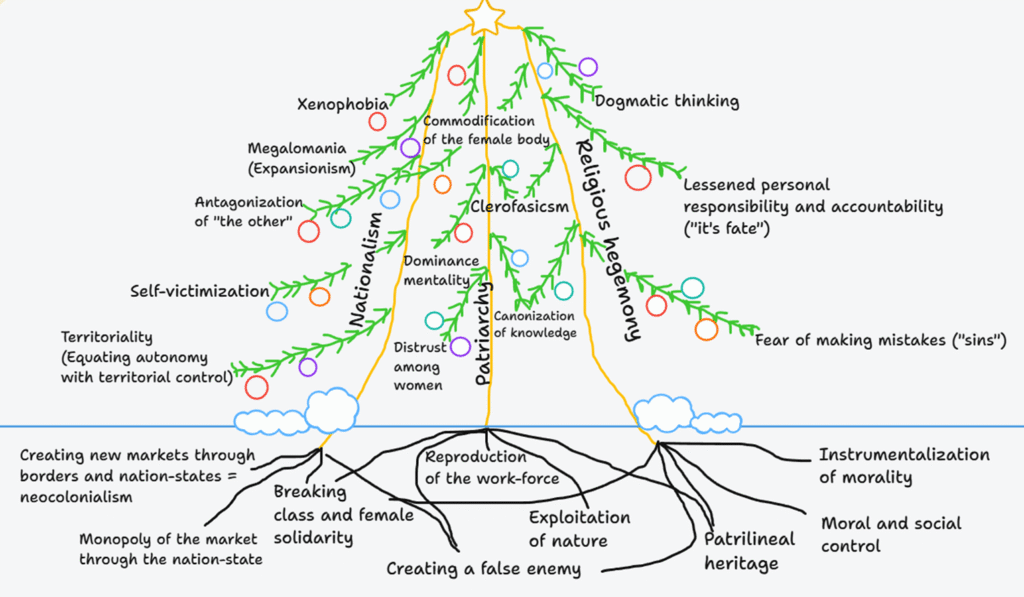
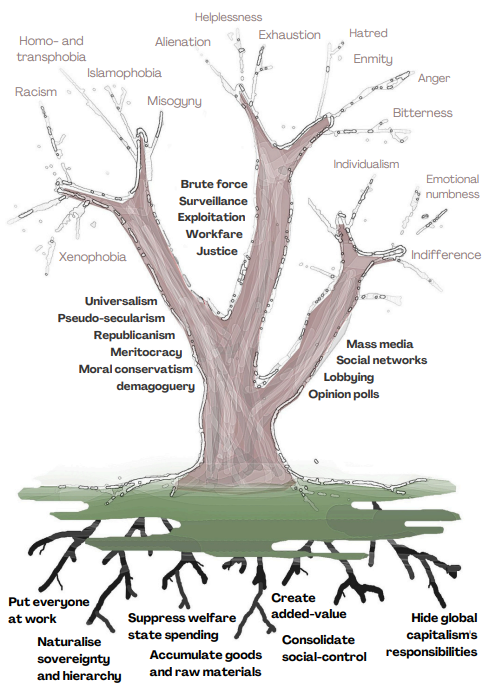
These trees come from the analyses done by the organizations in the working group. The top one is from the Dunja Social Center in Macedonia, and the bottom one is from L’Offensive in France.
Problems of ideology: To create a free life, we need to free our minds
If we don’t develop a strong ideology and a communal life, then liberalism, individualism, dogmatism, and sexism will be destructive and will put a burden on overcoming the political and organizational weaknesses of radical movements in building a revolutionary perspective/process, leading us directly to heteronomy and subservience. We have often seen the focus to be driven away from the essential collective needs and based on mistrust, internalizing fear, and reducing to individual projection the continuous denial of being in the process of finding solutions.
This also leads to the disconnection within us, with our own history, with our own knowledge. It doesn’t allow us to develop a power able to cope with the direct attacks of repressive forces (constant surveillance, criminalization of the struggle,…), to fight against the capitalist system as a whole and develop our own revolutionary processes.
In this sense, it is essential to point out that the attacks of capitalist modernity against society have resulted in the underdevelopment of the imaginary and a lack of imagination and creativity. Again, this can only be remedied by developing autonomy, liberating and regaining space of collectivisation, of self-education and by seeing with our eyes from the smallest to the biggest steps that something else is possible.
After the collapse of real socialism in Europe, hopelessness has sunk deep into society and its anti-systemic forces, with the spread of the concept of “there is no alternative” to the growing strength of liberalism. People no longer believe in real change, all hope seems to be lost and we are fighting just to keep things from getting worse. With the attacks of the special war, this often leads to fatigue, inertia and a permanent burden of political activism. It is the attacks of the patriarchal-capitalist system that isolate us, rob us of our strength and separate us from our history of resistance. Although the third world war is gaining momentum, the voices of rebellion are quiet. But if there was no hope for change, why is the system in such a crisis? We have a moment of chaos that we can harness for ourselves, that holds the hope of change and that will lead us to success with each person’s effort. However, for this a clear ideological line is needed.
Nowadays, the left in Europe is characterized by different ideologies. Post-structuralists claim to overcome the old, but they usually deconstruct everything so that nothing remains of it. At the same time, there is a lack of understanding of why an ideology is so important for the struggle against the enemy and why the enemy has secured its hegemony in the system through its ideologies. Eclecticism keeps organizations from developing a clear, coherent ideological line. In simplified terms, eclecticism means putting together a world view from different theories so that it fits into one’s own world view. For example, a concept such as criticism and self-criticism is often used in different contexts without a deeper examination of the meaning and depth of this method. This results in a liberal approach and the methods are not able to develop their full effect. It is not a question of not making reference to different struggles, as Abdullah Öcalan also did in his defense writings, but picking concepts of different theories, as is often the case in the left, prevents clarity and the ability to analyze. In Europe, liberalism is very strongly anchored in society, and we think we can always choose anything we want, but for a revolutionary change we cannot work with these individual choices of theories and concepts; instead we need a coherent ideology.
We are also limited by Eurocentrism and Orientalism, which prevents us from developing a truly internationalist struggle.Eurocentrism is expressed through skepticism and distance towards revolutionary forces outside of Europe and, even if not obvious, giving priority to our own perspective in Europe. Although this is discussed time and again, there is often a lack of viewing one’s own struggle critically in a wider international context. At the same time, if the struggle is not strongly anchored in one’s own society, and there is an excessive focus on the outside world, then the struggle can not be fought with one’s own identity and social character. This is a problem, as it prevents local issues from being discussed. An orientalist understanding (considering especially the Middle East as “the other”, not related to processes in Europe) also stops us from giving the right meaning to internationalism and to see our internationalist responsibility in these historical times.
In Europe, we realize above all how much our culture and identity have been shaped by a nationalist view. In the places where we grow up, we are usually unaware of our history, and especially of society’s resistance to the system. Where once thousands of different languages and cultures existed in Europe, we find a cemetery on whose graves a new liberal, capitalist way of life has been created. Even if several peoples in Europe have protected their ancient cultures, languages and clothes until today, often they have been deeply integrated into a nation-state. Especially today, there is a strong assimilation policy of these cultures, so that much of their knowledge and languages are in a fight against the uniform culture of the states. It is therefore very important for us to develop a culture of democratic modernity, together with the autonomously organized peoples, cultural movements and different ethnicities of Europe.
We need to create a complete struggle, which connects and combines an ideological, theoretical, philosophical/scientific approach with organization and action. For this, education plays a central role. In Europe organizations lack a deeper understanding of the importance and meaning of education to free our mentality, and to answer the question: who am I and how to live a free life? Without a clear mind and understanding, it is impossible to organize a successful action according to our ethics and aesthetics. For this, education does not only have a tactical but a strategic importance. Education is the key to fight against the patriarchal mentality, but also to build democratic modernity and autonomy in practice. In order to solve the problem of disconnection between theory and action, we need to fight against the positivist mentality.
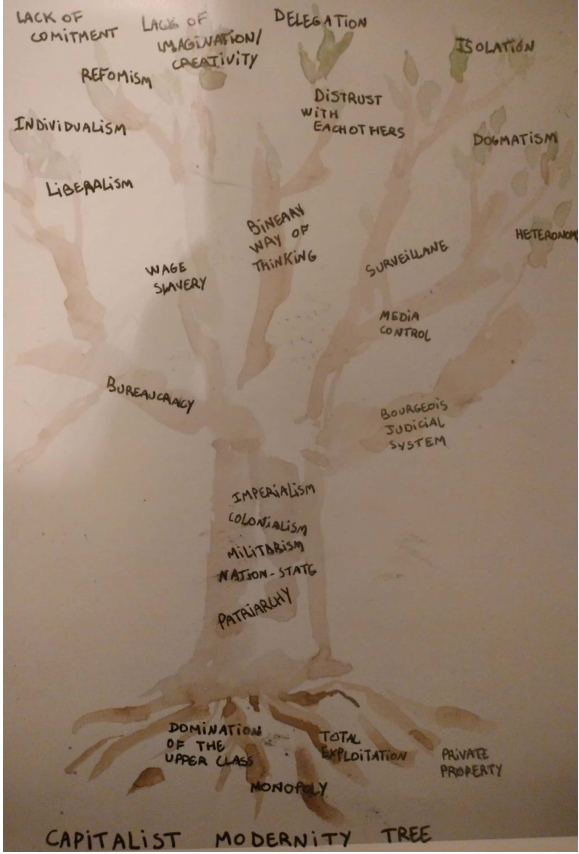
The capitalist modernity tree created by Prosfygika (Greece)
Organization is needed to face capitalist modernity
The way we organize is central in facing capitalist modernity. Because organization is so central, it is also attacked in many ways. This analysis should only give a short overview of the different ways and problems of our organizations.
As we are organizing with each other, there is a deep sense of distrust. Distrust is something based in capitalist modernity, where the world and people around us are only looking out for their own interest and profit. Throughout history, we see how the system was trying to spread distrust in society to destroy rebellions. For example, in the times of the peasant uprisings distrust was spread between the newly built colonies in North America, where peasants and slaves from all over the world were organizing together. Or we can take the example of the witch hunt in Europe, where distrust was spread between families to attack the wisdom of women and betray them to the authorities.
This distrust also creates conflicts, which can stop groups from working together or even split and destroy organizations. Often, the reasons for the conflicts are small, but because there is not a common ideological basis or way to analyze the problems and find solutions collectively, conflicts are a big danger for organizations. Conflicts often result out of a dominance mentality, which cannot accept and have empathy for different strategies and discussions.
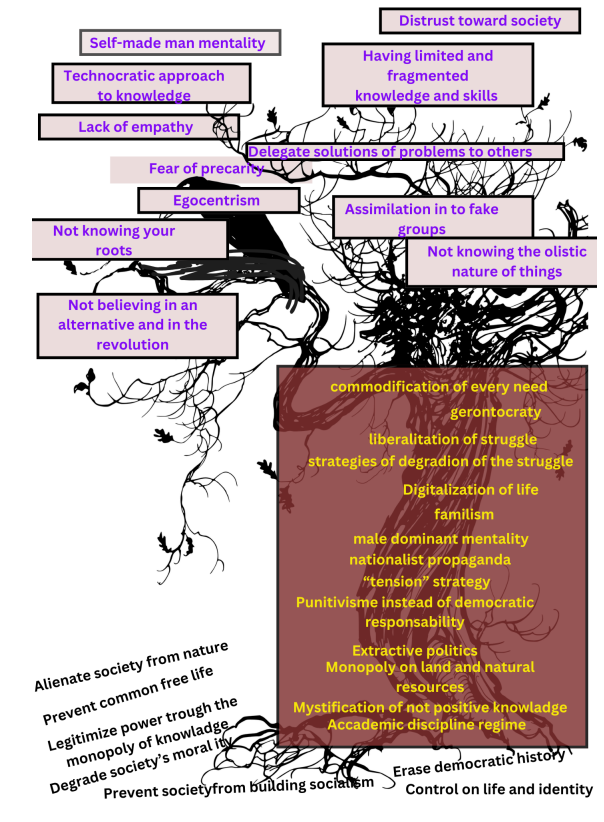
The tree created by Neighborhood – Organization (Italy)
While we are confronted with a mostly well-organized system structured by nation-states, patriarchy and capitalism, we can repeatedly see the opposite in our left-wing, feminist, ecological, and anarchist movements in Europe. We see many isolated collectives, but it is difficult to consider them as one organized structure. Fragmentation is dividing our movement in lots of small groups, so that we cannot face capitalist modernity together. We tend to focus on the differences between us and see them as something negative instead of seeing the beauty of our diversity. Since we cannot come together at the local level, we are unable to develop a common strategic approach with a concrete goal and program for an alternative at the global level.
In Europe, we find it difficult to organize, to structure ourselves beyond a certain bubble and to become a mass movement which can sustain itself in the long run. Liberalism and individualism lead to a false understanding of organizing. How can we organize ourselves, what does a democratic way of life look like? The discussions about this are always based on individualism and any form of organization is quickly dismissed as generating hierarchy. Nevertheless, it is of course very important to discuss a common form of organization. This should be approached with a critical discussion in order to be able to learn from each other.
We should also clarify our understandings of leadership and hierarchy. What does a democratic leadership mean? How can we create a democratic leadership in Europe and what can it look like on a practical level?
Through conflicts between ourselves we become our own barriers. Abdullah Öcalan says that 95% of the battle is within ourselves because the system is also deeply embedded in our own personalities. It is therefore not surprising that personal conflicts repeatedly arise in groups and organizations, leading to the destruction of entire organizations. As we are unable to deal with our own personality problems and defend ourselves ideologically, patriarchal attacks occur time and again. These conflicts manifest as superficial disputes, but are actually the expression of an unequal spirit of organization, such as the lack of commitment, which stops the process and prevents us from finding motivation in the work that we are doing. But how can we address this lack of commitment without falling into the trap of the excuse of capacities?
Organizations are also struggling because of the numbness and fear of persons in the group. The fear of what is happening, the overload of news of the third world war, their own contradictions with the patriarchal-capitalist system and so on. This leaves us without an alternative and we become weak, so we have to understand that these are precisely the attacks of the system meant to weaken us. It is not the single person who is afraid or numb, but a global system trying to focus on the individual, so that we don’t find our strength in the collective. To just see our own weakness and to focus on our own needs will not build up an alternative. To overcome fear and numbness, we need to show that we can do it beyond the state, violence and power; we need to work on the alternative.
We also need to clarify the relationship of our organization and the state: we often lack a deeper understanding of organizing democratic autonomy within the state system. State and democracy are not one and true democracy is anti-state, yet, on a daily basis, we are confronted with state institutions that we cannot destroy immediately. But when is the moment to enter into confrontation with the state, what does militancy mean in a deeper sense and how do we deal with the institutions of the state in our neighborhoods? Can we ignore them, can we exploit them for our own interests? How can we show society that the state is the one that has taken away our ability to organize, provide for ourselves and defend ourselves? Especially in Europe, we see how strongly the state mentality is also reflected in our organizations, and at the same time how necessary a clear alternative and perspective other than the state is also sought. We should not forget: strengthening democracy means drying out the state.
Another problem we are confronted with in Europe is marginalization. If we are not connected and anchored in society when building up organizational structures and communes, we cannot analyze and understand the problems of society and will not reach a solution. Society should not be seen as an object that can be molded from the outside. Rather, society itself is the subject and the power for change already lies within it. This does not mean accepting reality as it is, but rather looking for the potential in society and actively working for a change together.
With this anchoring in society, there is also the question of organizing around the material needs of society. Lots of movements are circling around the question of money, how to finance themselves and how to be politically active without being in the need of money. How can we sustain ourselves financially and materially? How much do we depend on money from the state and what does this mean for our political projects? We need to move towards a communal economy and create structures through which society can support organizations with material and donations. Recognizing our own capitalist and material practices and needs, and freeing ourselves from individualized ways of life is therefore important to build up autonomy in practice, which will dry out the nation-state.
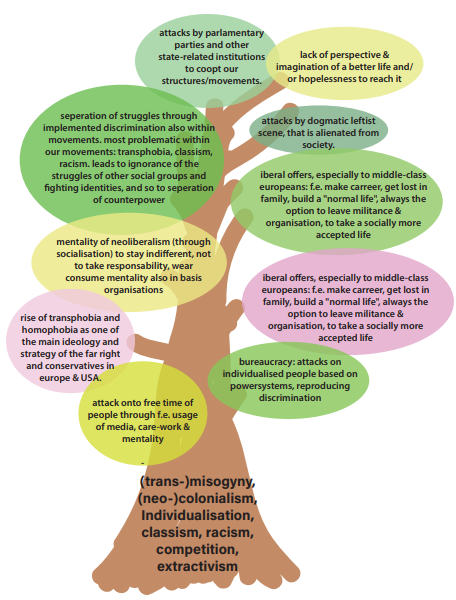
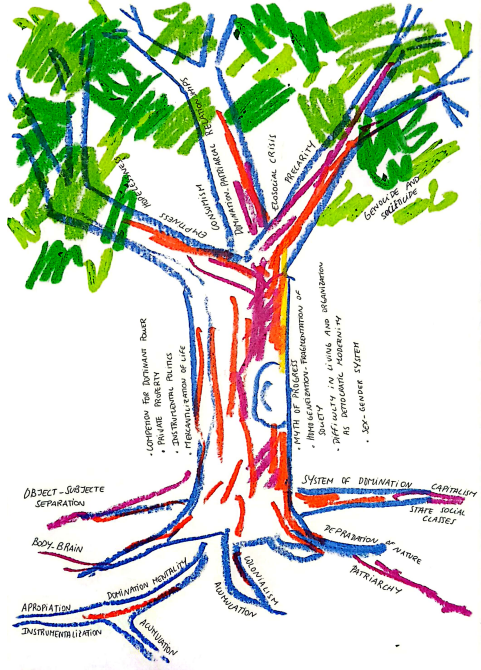
These are the trees of IDK – Germany (left) and La Sao – Catalonia (right)
Society as our basis to struggle internationally
While understanding the history and the struggle for women and society, we need to understand what it means to realize self-government, self-sufficiency and self-defense. We need to restore the meaning of this word and learn from experiences around the world. What does society think, what do other organizations do, what is our perspective? There is the need for a solid and structured network that allows this exchange of knowledge, that allows the growth of vanguards and that self-organizes as an example. Organization on an international level in Europe is of great value to share experiences, act strategically and realize autonomy. With the People’s Platform of Europe, there is the possibility to plan and realize a future plan. For this we want to share concrete plans and proposals after the platform. One idea would be to deepen our understanding about building autonomy, to write a brochure and also to combine our ideological and theoretical approach with praxis and right action.
We have already written a lot about the current times, how the chaos and the crises are intensifying, which also leads to a search for answers and solutions in society. In Europe, the anti-systemic forces were not organized well enough to create a voice in society and due to the many problems discussed above, no mass movement could be created. If we are looking for an alternative, for a free life, we have to answer these questions.
Often in our movements, there is no strategy as to why something is being done, there is a lack of ideology, organizing is rejected, and actions are done only from time to time. So what are our answers to these questions? What stops us from building autonomy?
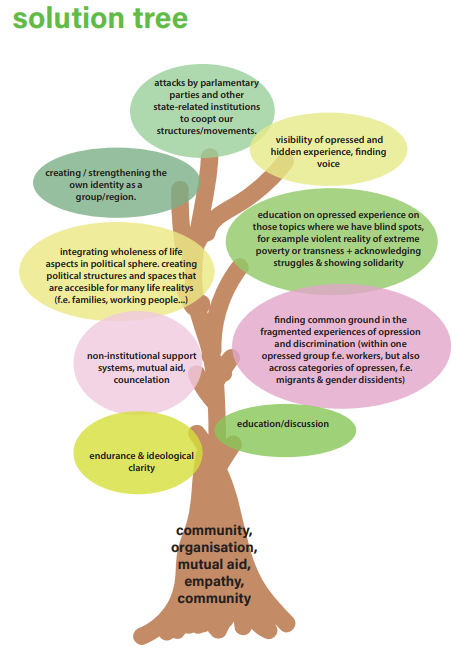
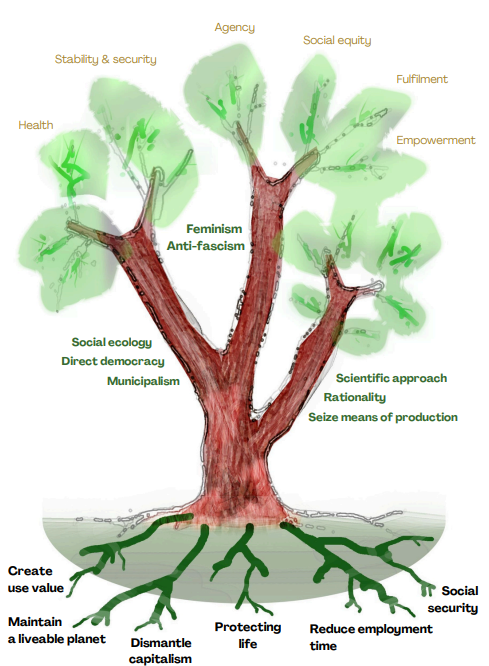
These are the Trees of Solutions from IDK (left) and L’Offensive (right), which leads us to the final workshop concept…